


 COVER STARS
DJ Plead: Neither here nor there
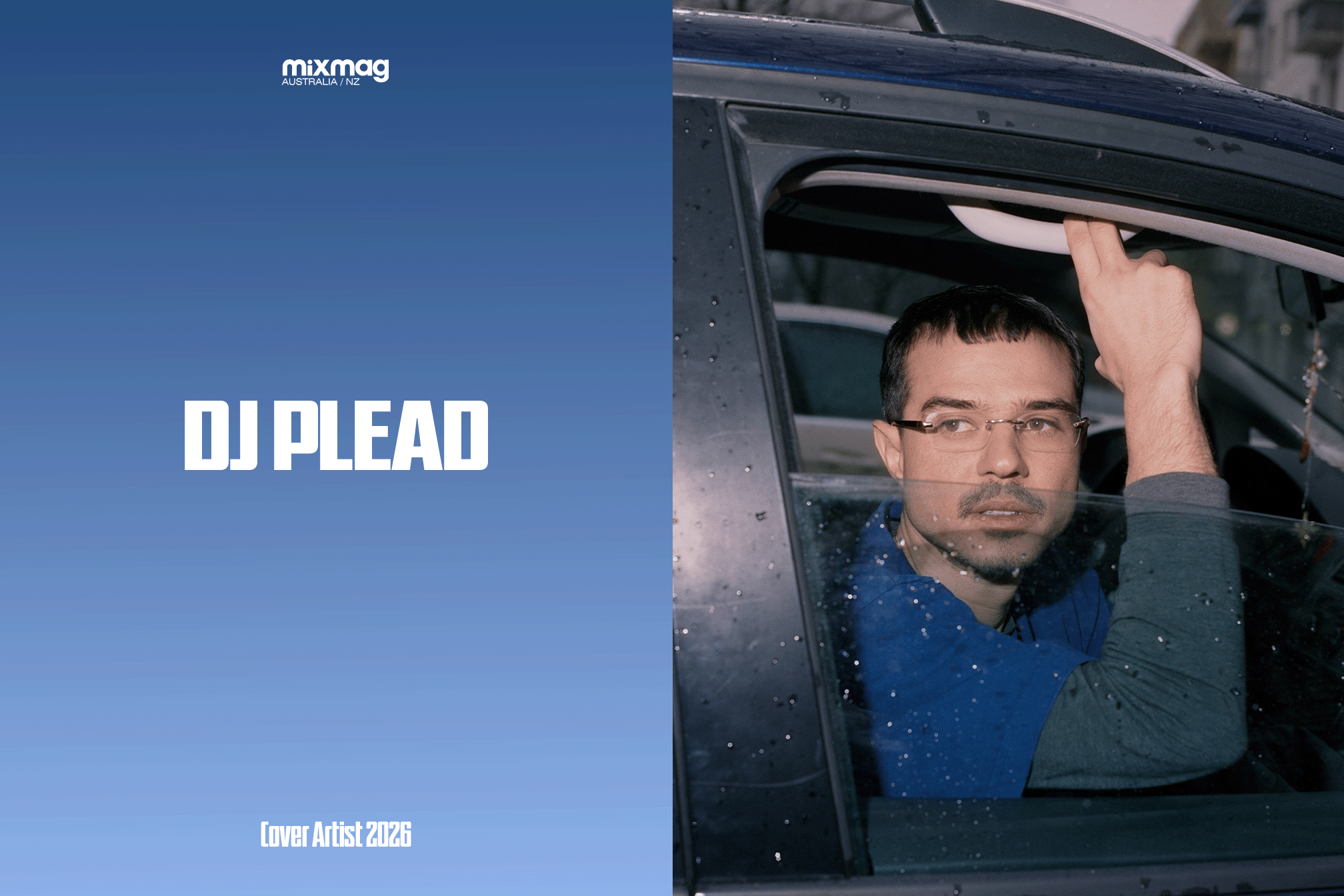
Fresh off the back of his acclaimed record ‘Please’, DJ Plead is Mixmag ANZ’s latest Cover Artist.
Imposter syndrome has, like many overused, more widely applicable psychological terms, become a placeholder for deeper personal dissection in recent years. Like so many others, it’s become a term people apply to whatever aspect of their life needs it in any given moment, like gaslighting, being a protagonist, and our ‘POV’.
It’s a term that comes up so regularly throughout my hour-long conversation with Gadigal Land/Sydney-originating artist DJ Plead, aka Jarred Beeler, that it stops feeling like a passing anxiety, and more like the central thesis of not only his latest record ‘Please’, but an overarching feeling towards his work.
He comes to this idea often, initially through recounting a recent trip to the much-adored English festival Free Rotation and later through his connection to both electronic music and his Lebanese heritage. In each discussion, he does so not with sadness, but with an understanding that he is not necessarily the way such a person in his position should be; yet he continues on and creates a life and a sound for himself inside that feeling, rather than shying away from it.
"I don't know exactly where the imposter syndrome comes from," he tells me at one point, thinking out loud, "but I think sometimes it's the emotions that are there first, and then you find a reason for feeling those emotions."
It’s a clear piece of reflection that many in Beeler’s position likely wouldn’t feel ready to question themselves. Dance and electronic music are increasingly becoming a less self-aware place, and the line between ego and total anonymity is one that few artists can tread, for arguably, that space is the most sensitive of all.
DJ Plead is Mixmag ANZ’s latest Cover Artist.
Beeler’s musical catalogue is one of self-discovery, having performed and released from an incredibly young age in his hometown on Gadigal Land. Brought up in the city’s Western suburbs, his musical experience began perhaps most officially when he started collaborating with his friends Marcus (Whale) and Lavurn (Cassius Select, LAVURN) as Black Vanilla, later renamed BV.
"I didn't really go to nightclubs that much," he says. "There was GoodGod, which I went to, but it wasn't regular DJ nights. It was very much a little live music thing." Bands like Zanzibar Chanel and Collarbones loomed large at the time, and Plead’s output was predominantly funnelled through local collaborations and live performances.
"For the first five years, it was all just with Marcus and Lavurn."
READ: 'Nether': Marcus Whale makes music to keep himself together
While many producers now are all too used to making music solo, from the comfort of their own home before moving into collaborative environments, Plead is somewhat of a relic of a previous generation of performers and producers. It’s in this experience that, perhaps unknowingly, he was learning to make the music he’d continue to produce well beyond BV’s final moments. Most obviously, those lessons included ones on restraint.
"Making music with Lavurn and Marcus meant I was making music for people to vocalise on top of. That's why my music is so stripped back and minimal." It’s this same environment that would lead him to better understand collaboration as a whole, a pertinent conversation given the success of recent collaborations with the likes of rRoxymore, Piezo and DJ Python. "That's just some good life advice. Just let it go,” he laughs. The afternoon after our call, a session with Québécois producer RAMZi is set to give him a taste of the more physical side of collaboration he hasn't felt in some time. A new record entirely from scratch. "It's way less engineer-focused, way more messy," he says. "It reminds me a lot of that early time collaborating with those two."
As is so often the case with people growing up in a country whose culture is so often processed through a white filter, Beeler has long been referred to by his cultural background. Though his father is Swiss and he attended a German-speaking school in Sydney, Jarred’s connection to his mother’s Lebanese roots, and especially its music, is one that has since 2018’s ‘Get In Circle’ defined his career.
In its earliest stages, Plead’s homage to Lebanese music was simultaneously clear and club-friendly. Often compared to wedding rhythms, or dabke, a style of folk, circle and line dancing, his earliest work made waves not only across Australia but globally for its use of sounds which, generally speaking, had not found their way into modern club culture.
As time has passed and Beeler has progressed, his interpretation of his inspirations and his understanding of his own work have become more abstract. On ‘Please’, an album built very much within the kind of imposter syndrome that he describes, the one thing that unites each of its tracks is that they don’t sound quite like anything else. It’s not entirely Lebanese, it’s not totally R&B, and it’s not club music.
They sound like an indescribable third thing. A style of music, a person and a perspective that DJ Plead experiences separately.
"I'm very much just existing in my own third culture kind of world," he says. "It's hard to distinguish between what's mimicry and what's just me now."
That’s the central idea that ‘Please’ spends its time trying to answer. Lebanese music, traditions, themes and tropes retold and replicated through Westernised electronic production ultimately won’t come out the same way. Here, Plead produces a hybrid art, one that doesn’t belong wholly to anyone, but instead acts as a kind of bridge to himself.
The writing of the record has come from a similar pursuit of understanding. Beeler wrote around a hundred demos before sending them to Joakim Haugland, head of the much-adored Norwegian label Smalltown Supersound. Enamoured with Haugland’s response to his demos, some of which were no longer than a few bars, the pair continued to go back and forth on pieces as they developed, until the record took the shape it has today.
That shape has seen it gain all manner of accolades, including a variety of feature album placements on local radio in Australia, including fbi radio, 3RRR and many others, and a slew of positive reviews across the remaining music media spectrum, both dance-aligned and otherwise.
‘Please’ sees a tonal shift from the club music that made DJ Plead’s name, a wide, appealing change juxtaposed most heavily with the sharp, percussive productions of releases like 2021’s ‘Relentless Trills’. That change is very purposeful. "I haven't really made that many club tunes in the last few years," he tells me. "It's like a five-year block of time since I've really been in that zone." Part of that shift, he says, has come down to a friend’s advice after hitting a club-sized creative wall. "She gave me some advice: just don't do it, just make other music. And I started doing this again, and it just comes out of me way more naturally."
In pursuit of what ‘good’ dance music should sound like, yet another facet of Beeler’s perceived imposter syndrome thrives. "I don't want to make like a standard techno tune," he says. "I experience a lot of imposter syndrome with dance music, and I feel like it would not cut above the standard." By comparison, ‘Please’ enables him a space and a corner of the musical world where he’s able to be more vulnerable in his experimentation. "When I'm making this kind of slower, more abstract music, I feel more secure."

In leaning further away from music predominantly made for club spaces, the inspirations that Beeler draws from become, in a way, even more pronounced, albeit retold in more abstract ways. But while in 2026 these Lebanese and Syrian influences on the record might appear as such in a vacuum, in his upbringing Beeler had these sounds reflected back onto him as their own third hybrid art: American R&B and rap. “A lot of my influences are refracted through the West,” he explains. “Scott Storch productions, or Timbaland, there’s a lot of dabke in them. A lot of Arab kids growing up identified with that, too.”
The idea of even needing to ‘untangle’ one’s influences, to decide where the influence on his work comes from at its core, appears to be of no concern to Beeler. It’s in that very entangling, however, and the unresolvable overlap that occurs between it, that art like Beeler’s is possible. "I couldn't tell you if that was a Lebanese influence sometimes or an R&B influence," he admits, "because what's in between that Venn diagram is very influential to me."
Influence, for DJ Plead, is not just a matter of inspiration, but mimicry too. It’s a topic he speaks of without any of the kind of sheepishness that one might expect, but more of a pride in the places he draws this incentive from. In its earliest days, this mimicry forged his keyboard skills over years of copying friends and peers before becoming his own. "The way I play the keyboard, I feel very much like that's just me," he says. "It does sound very Lebanese. It is quite Lebanese, because I am." When I asked him: at which point does your mimicry become something that’s entirely your own, Plead was entirely uninterested in drawing such a line for himself.
"I don't think there's ever a moment where I'm not in some way mimicking something that I admire. And I think if I stopped doing that, it would stop being interesting."
Beeler’s refusal to claim total authenticity over his work, whether through mimicry or, once again, through his self-perceived imposter status, is a feeling that extends, tellingly, to his relationship with Lebanon itself. Though more a hyperbolic conversational admission than a shocking truth prepped for an interview like this, he told me he’d never taken his music to a producer in Beirut to see what they made of it. So too, in retelling a story about a club gig some years prior, his recollection is one of self-deprecating embarrassment, where playing his own productions didn’t seem to win the audience over. "I just assumed that people would be down for it, but they didn't really love it."
"That's part of being sort of mixed race and growing up in Australia," he says. "You don't have that much connection to the music culture that's happening in Lebanon as such. But I have my own little world that I've created for myself."
In preparing for our conversation, I anticipated a series of threads. Beeler’s explanation of the kind of comfortable acceptance he has towards not totally paying homage to any one type of music, and a less-than-active desire to understand that acceptance, was one that I didn’t expect. It’s become telling that, in the speed at which the modern media cycle moves, particularly when it comes to the ‘relevance’ of artists and their perceived point of difference, I’d wrongly assumed that Beeler was trying to say something profound with ‘Please’. We’re told, albeit silently and through the context clues of the internet, that we have to say something. Instead, Beeler feels something first.
It was in this moment of recapturing my conversational bearings that I brought my final question, intended to be a far more casual, warm and humorous one, into a more serious discussion. What did Beeler’s family make of his music? While Beeler was somewhat dismissive at first, it became clear that, in fact, ‘Please’ had touched many people in his life.
"Mum said she listened to it from start to finish and really enjoyed it," he says. There's an aunt, too, who runs a Lebanese restaurant, "shout out to Layla's, everybody should hit it up", who plays his music there. "My brother-in-law loves it, listens to it on the way to work. My sister's been playing it for my niece and nephew." He sounded faintly surprised by his own family's enthusiasm as he listed it off. "I think my family's into it, now that I think about it."
The experience of diaspora and that of the homeland, as Beeler made clear, are not the same thing, but they’re also not entirely unrelated. It’s in the sustained overlap of those two experiences, and particularly their misunderstanding by non-diasporic audiences, where Beeler feels he’s most regularly involved in conversations around “representation”.
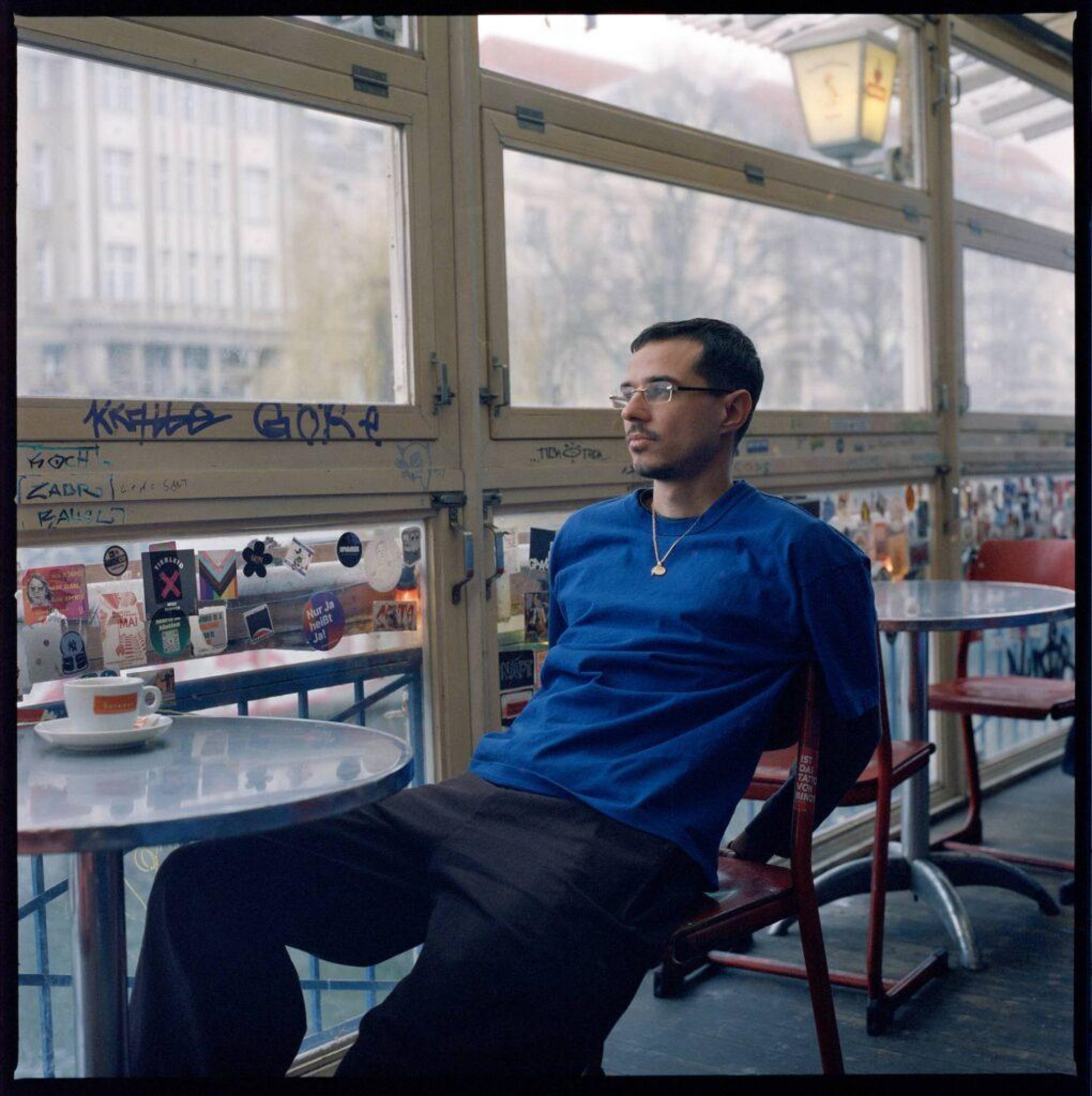
For a time, that same sense of representation led him to grow concerned about being pigeonholed and expected to play only “Lebanese adjacent music,” but that has resolved itself with time and a larger body of work to back him up. What remains is something far closer to gratitude.
Within that responsibility, however, comes the forcing of mental, emotional, and physical labour by global forces, as many in the diaspora globally have experienced. Beeler and other artists of Arabic descent did not ask to be politicised, and yet he doesn’t flinch from the idea that Arabic music has an inherently political quality in modern times.
While Naarm/Melbourne was his home for some time, Beeler is now based primarily in Berlin, a city which, despite its global reputation for artistic freedom, heritage-listed club culture and more progressive politics, has become one of the most violent places to protest. "It does feel powerful," he continues, "especially hearing it in a place like Germany, which is such an anti-Arab, Islamophobic culture. It does feel subversive to hear a dabke just ripping it up on a German dance floor. I feel satisfied with that." While that may not change the perspective of many in the club, I put to Beeler that this, if anything, might be decent motivation to do it even louder and more frequently, and to unify other Arabs.
“Totally," he agrees. "That's worth it more than anything else. That's a political movement itself, you know."
In that sense, ‘Please’ is much the same: not a grand, unifying statement, nor a diplomatic gesture or even a resolute answer to “sounding” Lebanese. Instead, it’s a record made from the idea that unresolved questions and feelings are worth exploring, even if it’s not done with answers. For him, like an increasingly growing group of diasporic artists forging their own identities, his work is proof that instead of finding his way out of an in-between space, so much can be built from within it.
DJ Plead, in the imposter syndrome he feels, the third-culture drift he experienced thousands of kilometres from his ancestral home, and the resulting mimicry that has helped define his career, has forged an ever-evolving artistic vision that, by nature, is unlike anything else.
-
Jack Colquhoun is Mixmag ANZ's Managing Editor, find him on Instagram.
