


 LISTS
LISTS
Machine Beats - exploring the sounds of ‘80s club music in Aotearoa
Writer Martyn Pepperell dives into a generation of club music defined by hairstyles and fashion changing more rapidly than ever before.
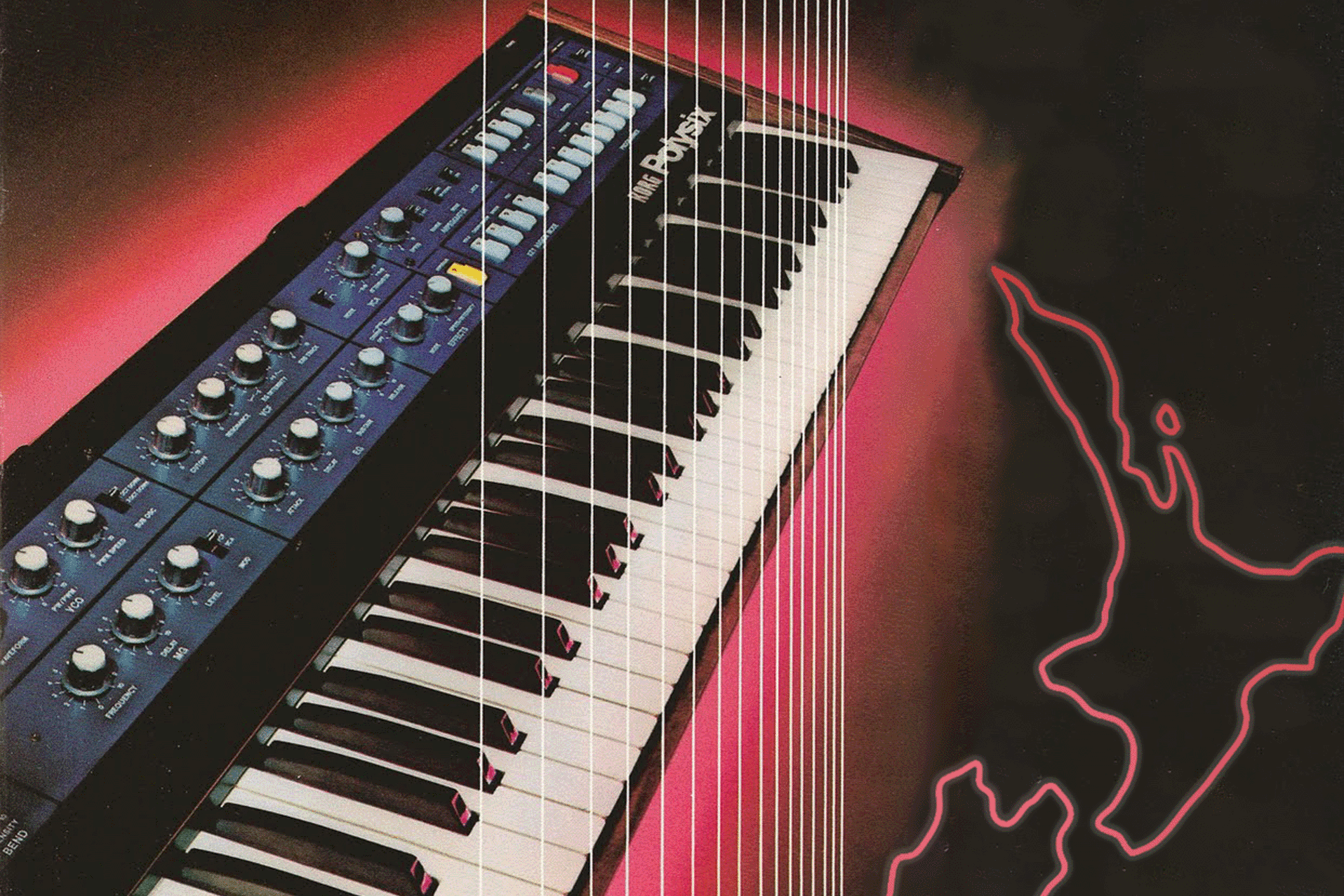
At the dawn of the ‘80s, the futuristic sounds of synthesisers, drum machines, and vocoders were making their way into soundscapes of nightclubs, radio stations and record stores up and down Aotearoa/New Zealand. By this stage, the classical composer Douglas Lilburn and his academic peers had been tinkering away at Victoria University of Wellington’s Electronic Music Studios for over a decade. During that time, the spacey sounds of Moog synthesisers were showing up on local prog rock records, and records by Donna Summer, Kraftwerk, and Gary Numan made an impression on local audiences. Hairstyles, fashion and music were changing rapidly. A new era was arriving.
By 1983, a generation of local musicians from across Aotearoa and Te Waipounamu, often hailing from punk, jazz, soul and funk backgrounds, were taking advantage of new electronic music technology to record their own takes on synth-pop, electro, EBM, uptempo R&B and proto hip-hop. Their arrival coincided with a wave of aspirational independent record labels, such as Propeller, Reaction, Jayrem, Maui, and Pagan, willing to take risks by doing things differently. Soon enough, some of the major labels were ready to get involved as well.
I was too young at the time to experience New Zealand's nightlife in the 1980s, but over the years I’ve been told stories by some of the first two generations of nightclub DJs here. I’ve also stumbled on locally produced 7” and 12” singles from the era in record stores, and spent countless hours digging around on YouTube, Discogs, history websites, and social media, while searching for the perfect ‘80s machine beats from Aotearoa.
As it turns out, some of the best examples of this type of synthesised magic were hiding in plain sight. Others turned up as the result of digging, asking the right questions and being patient. Here’s a rundown of ten synth-pop, minimal wave, electro, and boogie tracks recorded in New Zealand during the decade of decadence.
There’s more out there to be discussed as well. Think of this list as a jumping off point for further discussion, research and work.
BALLARE - ‘DANCING’ (PROPELLER RECORDS, 1983)
Ballare was a short-lived minimal synth-pop group that performed in nightclubs around Tāmaki Makaurau in the early to mid-1980s. In 1983, their signature track ‘Dancing’ appeared on ‘We'll Do Our Best’, a compilation of new local bands released by Propeller Records. In an interview with Andrew Schmidt for Audio Culture, Ballare member Eric Roulston remembered the group using Korg and Roland synthesisers and drum machines while recording the songs' sophisticated, techno-utopian backbeat. Decades later, hearing ‘Dancing’ inspired Strangelove Music boss Ben Stevens, aka Longboss, to compile and release his label's “Kiwi Animals: Future/Primitive Aotearoa ‘82-’91” compilation album.
CAR CRASH SET - ‘FALL FROM GRACE’ (REACTION RECORDS, 1983)
Emerging out of Tāmaki Makaurau’s post-punk scene, Car Crash Set began as the duo of David Bulog and Nigel Russell, before expanding to include a larger, rotating roster of members. After appearing on ‘We'll Do Our Best’, they released the ‘Two Songs’ EP through Reaction Records. While much has already been made of the snappy, technopop sensibilities of the A-side ‘Outsider’, the B-side ‘Fall From Grace’ is a remarkably prescient proto-synthwave number. Immaculately produced, it sits well alongside trends of the time, while still pointing towards the future. You can read more about Car Crash Set over on Audio Culture.
THE BODY ELECTRIC - ‘RUBBER KNIFE’ (JAYREM RECORDS, 1983)
While Car Crash Set were bringing machine beats to Tāmaki Makaurau, The Body Electric were doing the same in Te Whanganui-a-tara. Formed by the guitarist-turned-producer Alan Jansson, the group included Andy Drey, Garry Smith, and, later on, Wendy Calder. After building a live buzz, they signed with Jayrem Records. Capturing the spirit of the times, their debut single ‘Pulsing’ spent eight months in the local charts in 1982 and became a club hit. The following year, they released a three-track 12”, ‘Dreaming In A Life’, which included a muscular instrumental titled ‘Rubber Knife’. Forty-three years on, it still sounds sturdy.
A note: In the ‘90s, Jansson went on to help create the seminal Aotearoa hip-hop, R&B and New Jack Swing collection, ‘Proud: An Urban Pacific Streetsoul Compilation’ (1994). Not long after, he produced OMC’s global mega-hit, ‘How Bizarre’.
PĀTEA MĀORI CLUB - ‘POI E’ (MAUI RECORDS, 1983)
In 1979, the Māori musician Dalvanius Prime returned home from touring Australia and Asia with his soul and funk group, Dalvanius and the Fascinations. I like to imagine him in Pātea in the early ‘80s, hearing the Space Invaders arcade game noises coming from the fish & chips shop and watching children breakdance to electro. With his masterpiece, ‘Poi E’, Prime took all of the above and combined it with poi rhythms and a waiata by the acclaimed te reo Māori composer Ngoi Pēwhairangi. The song went to #1 in Aotearoa in 1984. Prime and Pēwhairangi are gone now, but their legacies feel eternal. Read journalist Graham Reid on Prime over at Elsewhere.
HERB MCQUAY - ‘NIGHT PEOPLE’ (FESTIVAL, 1983)
New York jazz and soul singer Herb McQuay washed up in Tāmaki Makaurau in the mid ‘70s after working the European cabaret circuit. In 1983, he cut his disco-funk masterpiece, ‘Night People’, at Mandrill Studios for the Festival record label. Decades later, the 7” single was given a second life when record diggers John Baker and Alan Perrott included it on their magnificent New Zealand disco-funk compilation album, ‘Heed The Call! (Whakarongo, Nga Tamariki)’ in 2017. McQuay returned to America in the mid ‘80s, where he continued to work as a singer until he died in 2005, aged 56.
SNAP - ‘SIDEWALK CITY’ (MUSHROOM NZ, 1984)
‘Sidewalk City’ was the first and only 12” single from Snap, the studio project of Tāmaki Makaurau musicians Graeme Gash and Tom Ludvigson, and the Harlequin Studios engineers Lee Connolly and Paul Streekstra. Alongside ‘Poi E’, ‘Sidewalk City’ represents a rare example of the ‘80s breakdancing era electro produced in Aotearoa. Alongside a funky synthesised machine beat, the song features slap bass by Max Stowers and vocals by Phil Steele, Annie Crummer and Jay Bula. The icing on the cake is the time capsule music video featuring a legendary breaking crew, The Megazoids. You can watch it over on YouTube.
READ: Exploring the sounds of ‘90s and early 2000s techno in Aotearoa
SHONA LAING - ‘AMERICA’ (PAGAN RECORDS, 1985)
By 1985, the New Zealand pop singer Shona Laing had been releasing music for over a decade. After living in the UK, she returned home and recorded her fourth album, ‘Genre’, at Mandrill Studios with the producer Bruce Lynch. In the ‘70s, Lynch spent a stint recording and touring with the British folk singer Cat Stevens. In 1977, he programmed ‘Was Dog a Doughnut?’, a techno-pop/electro instrumental for Stevens tenth album ‘Izitso’. While Lynch was recording ‘Genre’ with Laing, they cut the minimal synth-pop tune ‘America.’ Two years later, she released her signature hit, ‘(Glad I'm) Not A Kennedy’.
OBSCURE DESIRE - ‘OBSCURE DESIRE’ (PAGAN RECORDS, 1986)
Until it was reissued in 2024, Obscure Desire’s self-titled 12” EP was one of the true rarities in Aotearoa’s leftfield pop canon. Named after the fashion boutique and salon they worked at, the trio were the club kids who decided they would make a club record. Their inspiration came from local DJs playing 12” extended mixes of their favourite hits in the early ‘80s. The results were a remarkable blend of proto-house, jazz-funk and art-pop. Although they didn’t get the kudos they deserved, their visions of crowds dancing to machine beats came to pass. Read more about Obscure Desire here.
ARDIJAH - ‘LIKE ME’ (WEA, 1987)
Recorded with funding from the inaugural Rheineck Rock Award, South Auckland polyfunk band Ardijah’s self-titled debut album (1987) was a treasure trove of soul, funk, R&B and electro shaped riches. One of the most interesting tracks on the album is the drum machine and synthesiser-driven number ‘Like Me’. Having worked with the new wave/electronic pop groups IQU and Car Crash Set, Ardijah’s leaders, the musician Ryan Monga and the vocalist Betty-Anne, already had a sense of what the future would sound like. Over the following decades, they became beloved by devoted audiences across Aotearoa, Australia and the Pacific.
SISTERMATIC - ‘MILLION DOLLAR (CLUB RICH MIX)’ (PROPELLER RECORDS, 1989)
This is a real “What if?” moment. The project, featuring former members of Tāmaki Makaurau ska band The Newmatics, the American rapper Koi-Ski, and the Samoan singer Sina Saipaia (who later toured with OMC of ‘How Bizarre’ fame), came together for one single, ‘Million Dollar’. The lyrics alluded to a dodgy futures dealer, Michael James Easton, who was arrested in Australia while on the run from the law. On release, ‘Million Dollar’ was pulled due to the threat of legal action by Easton’s lawyer. Still, a number of white labels and promo copies made their way into the world.
-
BONUS
SHANE - ‘TOTAL MAN’ (WEA, 1984)
In the mid ‘60s, the British singer Shane Paul Arthur Hales washed up in Tāmaki Makaurau, where he fronted a band of Australian rhythm and blues musicians, The Pleazers. Later in the decade, he went solo under the mononym Shane, and had a hot streak of chart hits. Music took him back to Europe, where he spent most of the 70s, before returning to Aotearoa after the dawn of the decade of decadence. In 1984, he released a technopop-slanted cover of ‘Total Man’ by the New Zealand studio group, The Totals. The results are a total “What if?” moment if I’ve ever heard one.
A note: Kudos to Guy Blackman and Matthew Crawley.
ADDITIONAL LISTENING:
THE SCREAMING MEEMEES ‘STARS IN MY EYES’ (PROPELLER, 1983)
MI-SEX ‘COMPUTER GAMES (SPECIAL DANCE MIX)’ (CBS, 1983)
PHANTOM FORTH ‘SAW YOU HIDE’ (FLYING NUN, 1984)
HOWARD MORRISON ‘AIN’T NEVER SEEN A WHITE MAN’ (1984)
STEP CHANT UNIT ‘PAINTING PICTURES (ALTERNATIVE MIX)’ (JAYREM RECORDS, 1985)
THE RAPTURE ‘PREY FOR TOMORROW’ (PAGAN RECORDS, 1986)
LOW PROFILE ‘THE CUTTING EDGE (DANCE MIX)’ (FLAMEWAVE MUSIC, 1986)
MOANA ‘KUA MAKONA (COMPUTER BLUES MIX)’ (MAUI RECORDS, 1986)
JAM THIS RECORD! ‘JAM THIS RECORD!’ (PROPELLER, 1988)
HEADLESS CHICKENS ‘GASKRANKINSTATION’ (FLYING NUN, 1989)
JAG MORITZ ‘BOOT UP (LET X = Y)’ (HIT SINGLES, 1984)
-
Martyn Pepperell is a freelance journalist, copywriter, broadcaster, photographer and DJ. Find him on Instagram.
