


 LISTS
An Incomplete Guide to Tlaotlon: New Zealand’s Forgotten 2010s Abstract Techno Legend
Writer Martyn Pepperell dives into the discography of one of Aotearoa/New Zealand's more unsung musical legacies.
In the early to mid-2010s, Jeremy Coubrough, the New Zealand musician, producer, and DJ then better known as Tlaotlon, was on a creative hot streak. Between 2011 and 2016, he created four albums, seven singles and EPs, contributed to two split releases, and appeared on five compilations. He released these through a dizzying array of independent labels worldwide, including trensmat, Epic Sweep Records, 1080P Collection, FatCat Records, Altered States Tapes, and his own World Memory imprint.
In the process, Coubrough came to cult recognition through what San Francisco’s now-shuttered Aquarius Records described as “A glorious, dizzying blast of abstract psychedelia, looped and rhythmic, rife with woozy low-end synth buzz, swirling tangled melodies, a robotic rhythmic pulse, sounds swirling and beats stuttering." If you dig into his discography, you’ll hear eras, scenes, techniques, and musical approaches collapse and fold into each other. At the time, his work represented a multiverse of sounds—Detroit Techno, IDM, footwork, kuduro, improvised psychedelic noise, to name a few—coalescing into something new.
In 2012, I came across Coubrough’s first Tlaotlon album, ‘Squirt Image Flex’, after reading a glowing review in The Wire. Three years later, I interviewed him for The 405, a British music website that no longer exists. He’d just released his 11th Tlaotlon project, ‘Natural Devices’, a stunning collection of high-gloss abstract techno tracks where phone alarms, smartphone app alerts and other digital sounds drawn from modern life dance with circling percussion patterns and a heartbeat bass drum pulse. I was absolutely enthralled then; I still am now.
During our conversation, he reflected on the conditions under which techno emerged, before contrasting them with the cultural, social, and technological shifts he’d observed over the 2000s and early 2010s. "The rhythms of techno made perfect sense at the time they were first made," he said. "Detroit had the automotive industry, and the idea of the factory assembly line seemed to influence the music of the working class. In Berlin, you cross that with the spectre of fascism and their military history, the sound of enforced order and stomping boots. Then when you add in the burgeoning utopian vision of the internet and the potential power of code and anonymity, 4/4 slamming 808 and 909 beats make perfect sense.”
After pausing to order his thoughts, he continued. “The cultural landscape has changed, and I wanted to do something different. I wanted to use super digital equipment, but I wanted my structures and forms to be analogue. I wanted them to have more in common with the way forces work in real or virtual environments. Gusts of wind, waves of data, swarms of pop-ups or insects, replicating viruses, globs of accumulated data—that was what made sense to me. I wanted, and still want to, invert the traditional rhythmic and functional mode of techno. I'm not saying this is how all techno should sound from this point; I just want to know what my contribution to it is, and what it could be."
Fascinatingly, Tlaotlon is only one part of Coubrough’s story. In 2001, he released a CD of eerily prescient electronica titled ‘Shake Your Space Traveller’ through Bevan Smith aka Signer’s Involve Records label. Released under the Mandrake alias, the music on the album was indebted to his love of electro, jazz-funk, Herbie Hancock, Boney M and Moog Keyboards, unusual influences for a teenager at the time. Less surprising, was how he also drew on sci-fi B-movie sound FX and 8/16-bit chiptune sensibilities of ‘90s Nintendo video game consoles. It’s hard to find, but absolutely worth the hunt.
Afterwards, he played drums, saxophone, keyboards, guitar, and various other odds and ends for a cluster of indie- and avant-garde-leaning Wellington bands, including Skallander, Marineville, Signer, Fertility Festival, and Orchestra of Spheres. He studied Sonic Arts at the New Zealand School of Music, then relocated to Melbourne, before heading to Berlin. After Tlaotlon quieted down, Coubrough’s name began appearing in the credits as a graphic designer and cover artist on albums by US producers like Fire-Toolz and Euglossine. His work for them was generally rendered in a 3D style that, in a sense, feels like a continuation of the Tlaotlon aesthetic.
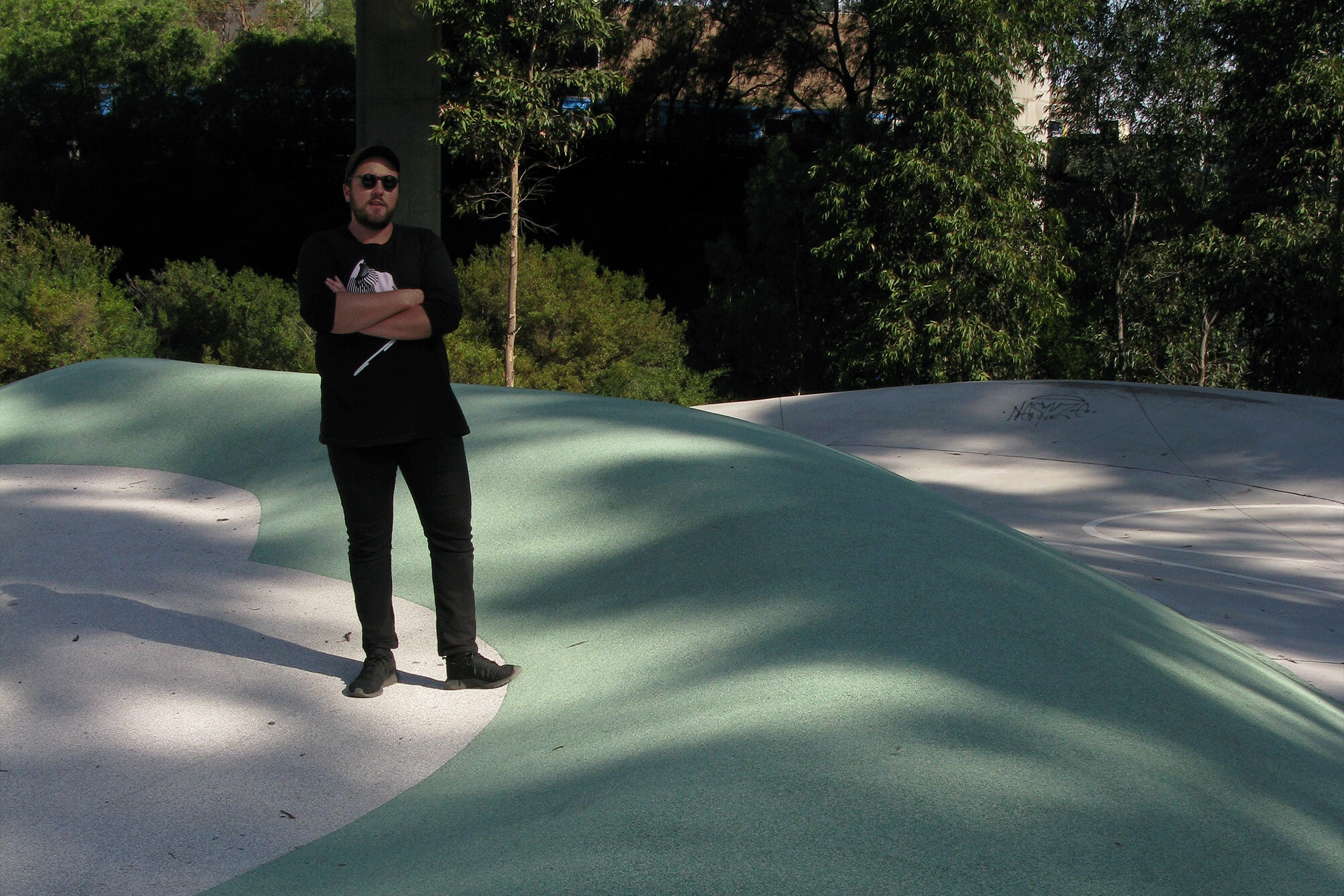
In 2019, Coubrough presented ‘The Smooth Jazz Conspiracy’, a documentary for Threads Radio about the dark machinations behind the downfall of smooth jazz, one of the most popular and reviled genres of the early 2000s. The last time I checked his Instagram page, I was greeted by a video of him playing saxophone in a suit, with devil horns emerging from both sides of his head. Sunglasses almost painted across his eyes, he went off in a vivid, emotionally expressive jazz style. Several carousel slides later, a suitably swinging drummer joined him, eliciting whoops and hollers from the audience. When I closed the app to get on with my day, I realised I’d been left with more questions than answers. Sometimes a bit of mystery is a good thing. After all, artists aren’t obliged to give everything away.
Lately, I’ve been thinking about how prescient Coubrough’s Tlaotlon music was. Despite the critical acclaim he received at the time, I’ve always had the lingering feeling his work deserved wider recognition. It’s been fifteen years since he launched the project. That feels like a significant milestone. A decade on from the last Tlaotlon releases, the themes he explored in his music feel more relevant and resonant than ever before. In fact, while I was finishing writing this article, I noticed the sampledelic Australian electronica group The Avalanches had just released a new album, ‘No Bad Memories’. On my first listen, I was intrigued to note they’d mined a similar strain of digital detritus to the online sound clutter Coubrough was archiving through music in the mid-2010s.
Here’s a guide to ten Tlaotlon albums, singles, EPs, and cassettes Coubrough released between 2011 and 2016. We’re all living in Tlaotlon world now.
‘SQUIRT IMAGE FLEX’ (TRENSMAT, 2012)
Released through the Irish record label Trensmat, ‘Squirt Image Flex’ was Coubrough’s first long-form Tlaotlon transmission. Across nine tracks with characteristically evocative titles like ‘Flayed Vert’ and ‘Spectrum Crypts’, he laid down a glorious vision of abstract techno psychedelia, bringing the freedom of free jazz into machine music. Equal parts layered, loopy, and asymmetrically syncopated, the album’s pixelated melodies, insectoid drums, and low-end synth drew strong praise across the blogosphere. These days, that ecosystem of music bloggers feels like a distant memory. At the time, however, they could push the dial for left-of-centre artists in wonderful and surprising ways.
‘CALAVITIES’ (EPIC SWEEP RECORDS, 2013)
In the 2010s, the New Zealand D.I.Y. label Epic Sweep Records released a flurry of lathe-cut 7”s, CDs, cassettes and LPs from some of the most fascinating figures in the noisy Aotearoa and Te Waipounamu underground: Kraus, Crude, Maxine Funke, Marineville and Tlaotlon to name a few. Pressed in an edition of 100 LPs, ‘Calavities’ continued the impulses that drove ‘Squirt Image Flex’. At the time, Under The Radar observed, “[‘Calavities’] has an experimental flair, with tracks that loop series of tense percussive rhythms beneath sweeping synths, reminiscent of some of the more abstract Flying Lotus productions.”
‘MAD IDEM! / OUDIMMA’ (VAUVA, 2013)
A two-track 7” for the Finnish experimental label Vauva, ‘Mad Idem! / Oudimma’ took listeners (and anybody who ever thought dancing to architecture sounded like a great idea) even further down Coubrough's tessellated wormhole. Opening with galloping drums that recall Angolan kuduro rhythms, ‘Mad Idem!’ quickly collapses into a cluttered beat mess before the drop clarifies everything and reveals one true distorted groove. On the B-side, ‘Oudimma’, he layers up hissy synthesiser pads, rich digi-melodies, hypnotic percussion loops and syncopated stabs. The track goes one way, then another, and another, and another. Call it ‘Choose Your Own Adventure’ techno, perhaps?
‘EKTOMISTS’ (1080P COLLECTION, 2014)
In the lead-up to ‘Ektomists’, Coubrough replaced his old PC (described as a rugged, dusty chunk of components in an exposed case with no protective panels) with a sleek new computer. According to the sales pitch, he also started loading Red Bull-flavoured vape fluid into a boxfresh E-cigarette while he was writing the EP.
This could be truth or hyperbole.
Either way, it evokes quite the image. Across four characteristically multi-rhythmic beat compositions, he leaned into a bright, melodic sensibility that reminds me of 16-bit video game music and ‘80s Japanese techno-pop. He also embraced sound design expansive enough to fill a high-end shopping mall at the end of history. Tracks like ‘Novodene’ ripple with life, or perhaps the synthetic simulacra of life.
‘SPLIT SERIES #23’ (FATCAT RECORDS, 2014)
For his debut on Brighton’s FatCat Records, Coubrough landed on a split 12” alongside the celebrated American sound designer and producer Katie Gately. While Gately turned in an epic, 14-minute modern classical composition, Coubrough opted for several shorter tracks in his signature, hyper-busy style. In a recommended review for Truants, Dublin writer, serial 2010s Bandcamp and SoundCloud release recapper and all-round top chap Aidan Hanratty observed, “Just as Gately redefines pop, so Tlaotlon reimagines the very idea of “dance” music.” From the first cascading soundscapes of ‘Myriade’ to ‘Siade’, Coubrough’s side continued exploring new ways in organised, psychedelic noise.
‘SPLIT’ (BABA VANGA, 2014)
In October 2014, Coubrough continued his run by debuting on Prague’s Baba Vanga label with a split cassette release with Czech electronica artist Střed Světa. The cover art appears to be a scan of a traditional cut-and-paste collage, which is as fitting a way as any of representing the music. In a review from that year, the Raised By Gypsies blog observed that Tlaotlon’s side had the quality of a pinball machine. They also compared it to 8-bit video game music and glitch-hop. I wouldn’t go that far, but I can hear IDM-related structures in the music.
‘RASH MAXIMS’ (ALTERED STATES TAPES, 2014)
‘Rash Maxims’ was an early cassette release on Altered States Tapes, a Tasmanian DIY label that later released crucial works from Keanu Nelson, Th Blisks, Troth, and YL Hooi. Over four extended edit-length tracks (7+ minutes), Coubrough moves between distorted industrial techno and bubbling braindance rhythms. Viewed through the rearview mirror of history, the music on here feels like a precursor to the slightly more straight-ahead (but not really) sensibility he mapped out with his 2015 ‘Natural Devices’ album. My favourite track on here is ‘It's Always Too Much, It's Never Enough’.
‘NATURAL DEVICES’ (WORLD MEMORY, 2015)
The ‘Natural Devices’ tape saw Coubrough refine and polish the syncopated man/machine rhythms and virtual-reality soundworlds of his earlier singles, EPs, and albums. At the time, he was thinking about the notification sounds, alerts, alarms and attention-grabbing noises that permeate modern life, and whether they could serve as proxies for pop hooks in electronic songwriting. The eight tracks that emerged from this process used a steady techno pulse as a safety belt, while taking us into an uncanny valley of sound. Released through his World Memory label, It’s his most accessible work, and yet somehow some of his strangest.
‘WIPER FBX’ (DREAM DISC RECORDS, 2015)
The version of Tlaotlon we meet on ‘Wiper FBX’ opens with a sweeping, sci-fi ambient number titled ‘AetherOS’, before quickly unfolding into glitching beat sculpture with ‘SAPIO’, ‘Virtu ’, and the tracks that follow. Released through the Montreal, Quebec-based label Dream Disc Records (later known as Dream-Disk Lab), ‘Wiper FBX’ taps a specific interzone between the plastic fourth-world sensibilities of Kankyō Ongaku (Japanese environmental soundscapes) and synthesised sounds conjured up during the 2010s deconstructed club music era in the UK. You can still hear something of ‘Natural Devices’ in ‘Wiper FBX’, but it’s on a different bent. Tlaotlon was changing.
‘ACACIA A/V’ (WEIRD EAR RECORDS, 2016)
Pressed on flexi-disc for the Oakland, California experimental music label Weird Ear Records, ‘ACACIA A/V’ might be a slim two-tracker, but every noise Coubrough deploys activates a cerebral pleasure centre. The sales notes describe the EP as exploring themes of biological defence systems, shape-shifting, and avoiding recognition. Opening with a steady bass-kick pulse, creeping insectoid percussion, and bouncy VGM melodies, ‘Turbo Mimosa’ slowly sneaks up on you, transforming asymmetrical shapes into a wonky stomper. On the flip side, ‘Nekta’ takes a similarly sneaky approach before gently fading from view.
-
Martyn Pepperell is a freelance journalist, copywriter, broadcaster, photographer and DJ. Find him on Instagram.
