

SXSW Sydney announces cancellation despite $276 million "economic impact" claim
Originally boasted as the first-ever global edition of the revered Austin-born festival, SXSW Sydney has announced its end, three years into a five year licensing deal.
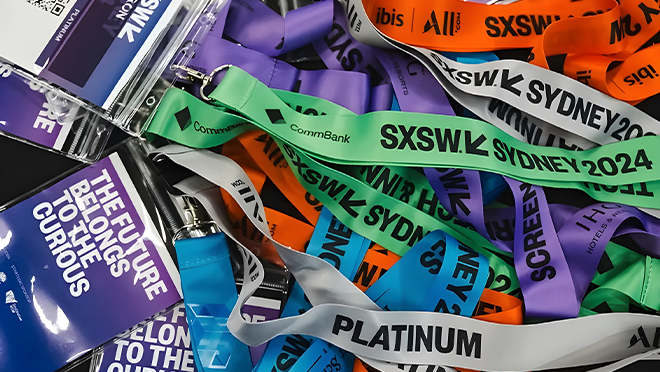
SXSW Sydney has been cancelled indefinitely, according to a press release shared by organisers today.
In a statement shared by TEG, otherwise known as Ticketek Entertainment Group, the company, which owns Ticketek, touring company TEG Live, TEG Sport, Laneway Festival and Qudos Bank Arena, SXSW Sydney’s cancellation “reflects a changing global environment that is impacting major events, festivals and cultural programs worldwide.”
TEG owns the license to organise SXSW alongside Destination NSW. In 2023, the deal was struck for Gadigal Land/Sydney to be the first-ever host city for the event outside its home of Austin, Texas, for an undisclosed sum, rumoured to be around $12 million. This money would, for Destination NSW’s share, be provided by the taxpayer.
However, after only its third edition in October last year, SXSW Sydney will no longer proceed.
“SXSW Sydney worked closely with the NSW Government and SXSW’s global owners, Penske Media Corporation to explore potential pathways forward for the event, however, prevailing market conditions mean the Sydney edition will not be going ahead at this time,” the statement reads.
Throughout this statement, TEG celebrates the achievements of SXSW Sydney despite its cancellation. “Between 2023 and 2025, SXSW Sydney generated an estimated $276 million in total economic impact. The event attracted more than 63,000 out-of-region attendees and recorded a 35% year-on-year growth in international visitation between 2024 and 2025. In 2025 alone, the event attracted a total attendance of more than 345,000, representing a 15% year-on-year increase.”
Despite these figures, the cancellation may come as a surprise to those familiar with SXSW's model, which ensures that its cost-effectiveness is at the core of how it functions.
Most obviously, their ticket costs. SXSW Sydney had long been criticised for confusion about who the festival was actually aimed at. Last year, the Sydney Morning Herald’s Bronte Gossling noted that “general confusion over what SXSW Sydney is and who, exactly, its audience is, saw attendance drop from more than 97,000 unique visitors in 2023 to 92,000 in 2024.”
A single-day pass to events taking place at the ICC cost $695 + booking fee last year. The ‘Pro’ pass, the second tier, was a 5-day conference pass that required buyers to choose a “festival focus” and cost $995 + booking fee, while the ‘Platinum’ pass offered “the ultimate 7-day SXSW Sydney experience” and cost $1,495 + booking fee.
If SXSW’s claim that more than 345,000 people attended the event is true, and every one of those people bought an even number of the above passes, then the total takeaway from ticketing last year would have been around $366 million. In reality, this attendance figure is likely an aggregate of ticketholders and attendees of free events across the festival.
Since its inception, SXSW Sydney has worked with a wide variety of commercial partners and sponsors, too. Last year, their partners included the likes of Commonwealth Bank, Accenture, QMS, Visa, Johnnie Walker, UTS, American Apparel, L’Oréal, KPMG, Uber, TAG, Adobe, RAC, Coles, Meta, WeTransfer, Moshtix, PWC and more.
In 2024, SXSW (Austin) was in partnership with the United States Army and defence contractor RTX Corporation. This partnership was discontinued after much backlash.
Whether in exchange for goods and services at a discounted rate, as a paid advertising partner or even as an owner of some of SXSW Sydney’s spaces - one of the most notable examples being American Apparel House, the launch venue of SXSW Sydney’s music offering - these brand partnerships would have served as another revenue source for the festival.
Finally, one of the most reputable ways in which SXSW’s model remains cost-effective is its approach to speakers, performers, and volunteers. The festival charges an application fee for performers and gives domestic artists a choice between payment and a festival pass. In early 2023, SXSW caught flak from artists for the pay rate at its Austin event, which at the time was $250 USD for a group and $100 USD for a solo act. Several months later, after a petition garnered thousands of signatures, SXSW increased that rate by $100 USD for groups and $50 USD for solo acts, but didn’t advertise the increase.
“SXSW’s pay structure has been one of their most shameful aspects the entire time,” Austin-based musician Thor Harris said of SXSW in 2023. “You do well and get accepted into SXSW, then you’re not supposed to say anything about the pitiful pay,” added Audrey Campbell, the frontwoman for a garage-punk band called Pleasure Venom. “Because being booked feels good, and it’s what you’re supposed to be doing as a musician, right?”
Gadigal Land/Sydney-based duo The Land Of Rah, made up of Julian Hovenden and Hugo Ferrer, shared that they were offered a choice between $350 AUD and an all-access pass in exchange for an appearance at last year’s SXSW Sydney.
“The only thing on our rider was a table to put our gear on, and they made us bring our own,” Hovenden shared. “The venue had loads of spares; it showed they (SXSW Sydney) didn’t even ask.”
On top of the rumoured $12 million the brand cost to license, Mumbrella reports that SXSW Sydney “received funding from the City of Sydney worth $300,000 in cash across all three years, plus $369,533 in value-in-kind, a third of which covered the venue fee waiver for its 2025 edition. The council then budgeted a further $100,000 per year for SXSW between 2026 and 2027, plus $424,000 in non-monetary support.”
In its first year, SXSW Sydney was expected to inject $24 million into the NSW visitor economy.
At the time of its announcement, many were quick to criticise the decision to fund an overseas brand rather than offer the same opportunity to locals. “If we have learnt anything from COVID, it is festivals need to emerge from the ground up, like the Melbourne and Sydney Film Festivals, which have a strong local base and are not an imposed, obvious commercial venture like SXSW,” Revelation Perth International Film Festival’s Richard Sowada said at the time.
As SXSW Sydney announces its end, the question remains: Where did all of this money actually go?
