


Massive Attack, King Gizzard and Laneway are helping bring wombats back to a Tasmanian island
With help from some of our biggest and most politically active musicians, the Tasmanian Aboriginal Centre is clearing feral cats from Lungtalanana/Clarke Island to return species wiped out after colonisation.
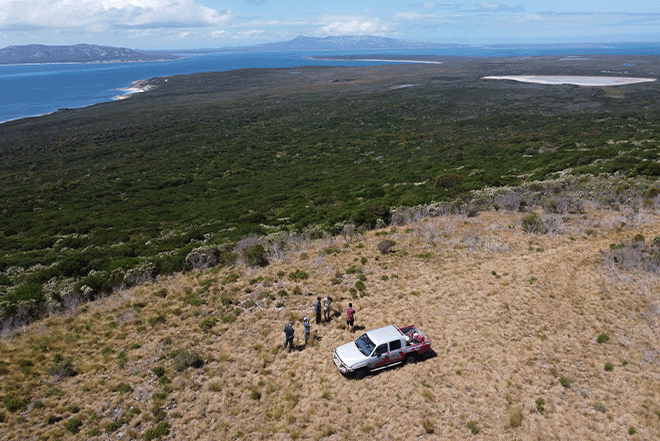
Wombats, wallabies and long-nosed potoroos once lived on Lungtalanana/Clarke Island, an island of roughly 8,200 hectares off Tasmania's north-east tip. Following colonisation, these animals disappeared, and now the island’s First Nations owners are working with key music industry leaders to help bring them back.
The island is part of the Furneaux Group, a group of approximately 100 islands located at the eastern end of the Bass Strait between Victoria and Tasmania. In 2005, after the passing of the Aboriginal Lands Amendment Act 2004, the island’s custodianship was returned to the Tasmanian Aboriginal Centre (TAC), marking the first official handover of Crown land to a First Nations community in Tasmania.
Grazing livestock, land clearing, and feral animals had already done huge damage to the island before 2005, and in 2014 a bushfire burnt through 98% of it. TAC's Pakana Rangers now carry out conservation work on Lungtalanana, pairing cultural burning with conservation science, and in a joint trapping survey with WWF Australia in 2024, they found no native animals remained on Lungtalanana at all, but around 80 feral cats.
In an effort to restore the island, TAC has launched the Healing Lungtalanana project, which begins with the removal of all the feral animals for the next two years, with years three and onwards focused on bringing its animals home: the Bass Strait wombat, the long-nosed potoroo, the New Holland mouse and Bennett’s wallaby.
A somewhat unlikely partnership has emerged to fund the project, with Healing Lungtalanana working with FEAT., an organisation founded by Cloud Control’s Heidi Lenffer.
FEAT. was created in 2019 when Lenffer realised just how much carbon a single tour burns, and is best described as a Future Super-partnered initiative, where artists can invest in environmentally sustainable projects and infrastructure. So far, one of its biggest successes to date has been the Solar Slice, a small add-on to ticket prices that goes to climate projects.
Lungtalanana is now the focus of FEAT.’s funding. King Gizzard & The Lizard Wizard's Croxton Block Party in Naarm/Melbourne this month put $1 from every ticket towards the island, and Nipaluna/Hobart's Festival of Voices did the same through its booking fees.
According to FEAT., the musicians and festivals also backing the project include Massive Attack, Missy Higgins and St Jerome's Laneway Festival, the last of which has already been involved in FEAT.’s Solar Slice program.
Working with GreenCollar, Australia's largest environmental markets investor, TAC will measure the island's starting condition, do the restoration work, then measure its improvement. Once audited, that improvement is issued as biodiversity credits that organisations can buy.
In its statements, TAC has been careful to separate these from carbon credits. Carbon credits let polluters offset their emissions, while TAC says biodiversity credits are bought voluntarily by people, governments and companies who want to pay for a measurable gain in nature.
So too, TAC frames the project as more than ecology. With TAC’s goals and FEAT.’s funding set to include jobs and training for Palawa people, passing language and culture between generations, and restoring connection to Country.
