


Daniel Ek in Australia: $200,000 for The Push amid Spotify’s lobbying campaign
The push comes as Australia's government looks to establish laws which would force streaming services to preference more local content.
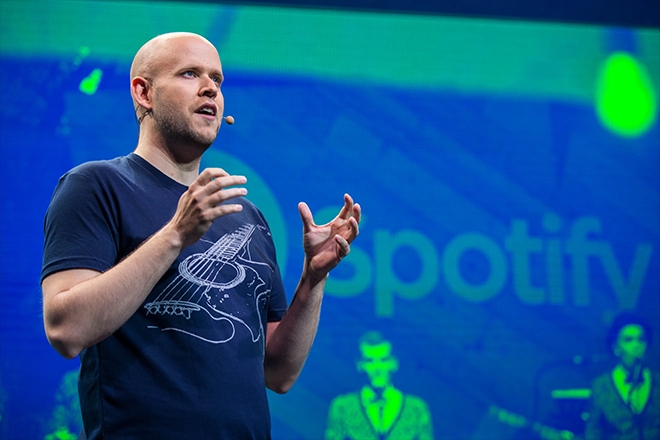
Spotify co-founder and AI military start-up Helsing chairman Daniel Ek has made a rare visit to Australia this week, coinciding with the Albanese government’s plans to force streaming services to “play more local music”, and is likely to have led the streaming giant to commit $200,000 to youth music organisation The Push.
As reported by SMH writer John Buckley earlier today, Ek had lunch with music industry bosses on Tuesday of this week, along with meetings with key Australian officials, as Spotify lobbies the idea that preferencing local songs will actually strangle musical exports.
Changes to these content laws sit under the National Cultural Policy, Revive, which similarly hopes to force streaming services operating in Australia to guarantee the funding and platforming of local film and television productions.
In critiquing the policy idea, Dustee Jenkins, Spotify’s global policy boss based in New York, called it a “defeatist strategy” and said that if such policies were adopted in other countries, they would only further hurt Australia.
“There is a reason that these are not done around the world, and that reason is that artists want to export in a really healthy way,” Jenikins shared. “That’s how you become a global superstar. That’s how you grow your listener base. No [artist] just wants only their neighbourhood, only their city, only their country [listening to their music].”
In recent years, Spotify has been described by many as a marketing company rather than a music company. One of its most vocal and well-known critics, Liz Pelly, wrote in her book ‘Mood Machine: The Rise of Spotify and the Costs of the Perfect Playlist’ that Spotify’s work extends far beyond music into data sharing and targeting.
“...Spotify has partnered with Facebook, Uber, Tesla, Tinder, and Virgin Airlines, as well as Ancestry.com and 23andMe, offering the last two companies “not only a new customer base but a new source of behavioural data, one that might profitably complement the genetic data they already possess.”
And to more broadly illustrate why else marketers and ad-tech firms as well as ‘credit agencies, banks, health-care providers, insurers, governmental agencies, and finance companies’ might want music-related data—beyond just Spotify and streaming data— (Eric) Drott points to examples that already exist: a start-up called Creditvidya, which has used music streaming data as part of its algorithm for approving loans, and the microcredit start-up Lenddo, which media scholar Robert Prey has noted uses concert ticket data as part of approving students for loans to buy textbooks.”
While Spotify’s own reputation has continued to degrade in recent years as its approach to paying artists has come under even greater scrutiny, Daniel Ek’s own investments have, to many, offered more insight into the company’s impact.
In June of 2025, Ek led a €600 million ($1.07 billion AUD) investment into Helsing, a start-up company specialising in AI military software and currently producing its own drones, aircrafts, and submarines, and is developing a new ‘Centaur’ system that will integrate “advanced AI pilots” into the cockpits of fighter aircrafts, Music Business Worldwide reports. This was only the latest in a series of investments by Ek and his firm Prima Materia, in the company, utilising the exchange of his Spotify shares to do so. He is now the company's chairman.
Read: Spotify CEO Daniel Ek becomes chairman of AI military start-up following $1 billion AUD investment
While Ek’s role as Spotify CEO ended on January 1st of this year, his influence on the music industry and governments around the world appears indispensable to Spotify.
Recently, Australia has taken on the role of a policy incubator, inspiring other countries to follow suit. In 2021, this was the media bargaining code, which aimed to force big tech firms to pay for the promotion of news on their platforms, and most recently, the under-16 social media ban.
Coinciding with Ek's visit was the announcement at a closed Spotify event on Gadigal Land/Sydney last night of a multi-year partnership with youth music organisation The Push.
$200,000 has been promised to the registered charity, whose purpose is “giving every young person the opportunity to participate and thrive in Australian music.” This funding, reportedly the largest in the organisation’s history, is set to aid its newly launched ten-year strategy.
This marks the first time Spotify has worked with the organisation, but it continues a trend of the streaming service funding youth music and mental health initiatives globally.
Of the partnership, Dustee Jenkins shared: “This is about empowering young Australians to connect meaningfully with music – having seen the deep impact and respect The Push has here in Australia, this partnership was a no-brainer.”
The Push’s CEO, Kate Duncan, said that the support’s timing was critical as the organisation enters its fifth decade.
At a time when Spotify looks to lobby Australia’s government away from content laws, the timing of such a partnership is very clear. Recent content from local music creators like Poppy Reid, Daphne Berry and Ash McGregor, among others, that pushes new Spotify features and is heavily criticised by their music-loving audiences may point to a broader strategy by the streaming giant.
In one comment on Ash McGregor’s paid partnership with Spotify, Gadigal Land-based artist Lucy Lucy said: “The fact you’re probably getting paid more to do this video than I earn in streaming royalties says everything tbh”.
In the midst of this PR campaign, it remains to be seen how Spotify can truly differentiate itself from any other global tech brand.
The Push’s 10-year strategy has three key focuses, namely:
- Access, education and real-world pathways into live music and the broader industry.
- Mental health, wellbeing and safe cultural spaces.
- Equity, representation and inclusion for underrepresented communities.
The question remains, however, can a brand that ran recruitment ads for U.S. Immigration & Customs Enforcement (ICE), that ran ads recruiting armed units for Israel’s prison service, and that donated to Donald Trump’s inauguration, a man currently denying any link to a global paedophilia and power ring involving Jeffrey Epstein, truly have the best interests of young people at heart?
As the boycott of Spotify grows globally, and artists and fans alike move even further onto platforms like Qobuz or Bandcamp, questions like these seem to linger more than ever.
